
When I coached at the University of Colorado, we had a player who rarely saw the court.
Let’s call her Mel.
Mel wasn’t on the front page of the sports section. She wasn’t leading the conference in scoring or rebounding. Reporters didn’t gather around her locker before or after games. Fans didn’t ask for her autograph.
Mel was the player sitting near the end of the bench. Now don’t misunderstand me. Mel wasn’t there because she didn’t care.
Quite the opposite.
Her warm-up jersey was just as soaked with sweat as our starters’. She attended every practice. She learned every play. She lifted every weight. She ran every sprint. She completed every conditioning drill. If effort alone determined playing time, Mel would have been one of the first players on the floor.
She was also one of our best teammates.
She celebrated every basket as if she had scored it herself. She encouraged teammates after difficult practices. She brought positive energy into the locker room. She never stopped preparing, even when her role rarely changed.
Then game night would arrive. The lights would dim.
The public address announcer would introduce the starting lineup. Fans would cheer. Parents would applaud. Statistics would flash across the scoreboard. The stars of the team would take the floor.
Meanwhile, a little farther down the bench sat Mel.
Ready. Prepared. Waiting.
As the game unfolded and substitutions were made, she watched the clock.

Every Athlete Knows That Feeling
You’re sitting on the bench, mentally locked into the game. You listen for your name to be called and you hope that tonight you get the call.
Sometimes you do and sometimes you don’t…get the call.
If you’ve ever been that athlete, you know the silent questions that begin to creep into your mind.
Do I really matter? Would anyone notice if I wasn’t here? Am I ever going to get my chance?
Those questions aren’t reserved for athletes. They’re asked every day in offices, hospitals, schools, manufacturing plants, nonprofit organizations, and boardrooms across the country.
Every organization has a bench.
There is always someone who wasn’t invited into the meeting. Someone who wasn’t selected for the high-profile project. Someone whose ideas haven’t been heard. Someone quietly wondering whether their contribution really matters. And some are quietly waiting for someone to show them they belong.
And that is where great leadership begins.
The greatest leadership mistake isn’t failing to recognize your top performers. It’s forgetting the people who are still becoming one. Because today’s last person on the bench may become tomorrow’s leader—if someone has the vision to develop them.

Leadership Development Requires More Than Developing Top Performers
As a Division I basketball coach for more than 30 years, I understood something every coach eventually learns. Winning matters. Results matter. Performance matters. Your job depends on those things.
But there is another responsibility that often receives far less attention. And that is developing every person entrusted to your leadership. That includes the All-American. But it also includes the athlete who may only play three minutes all season.
Here’s why.
Not every athlete contributes on game day, but every athlete contributes to culture.
The player who brings energy to practice. The teammate who encourages others after mistakes. The athlete who pushes starters every single day during drills. The player who models resilience despite limited playing time. Those contributions rarely appear in a box score. But championship cultures are built on them.
Business operates exactly the same way.
Leadership can become so focused on quarterly goals, productivity metrics, client deadlines, and organizational outcomes that it unintentionally overlooks the people still searching for their place.
Over time, those employees begin believing something incredibly dangerous:
“My contribution doesn’t matter.”
And once someone believes they no longer matter, disengagement quietly begins. Rarely does this happen overnight. Usually it occurs with one missed conversation at a time. One overlooked idea, forgotten opportunity, meeting they weren’t invited to, or project they never had the chance to earn. Eventually, they stop raising their hand. Not because they stopped caring. Because they stopped believing anyone else did.
Employee Engagement Begins With Leadership
Many organizations spend enormous resources trying to improve employee engagement. They redesign offices, add wellness initiatives, provide free lunches, or introduce new technology. Those investments have value. But they often overlook the greatest influence on engagement.
Leadership.
According to Gallup, managers account for approximately 70% of the variance in employee engagement. In other words, employees don’t experience culture through mission statements hanging in the lobby. They experience culture through the person they report to every day. Gallup has also consistently found that employees who receive meaningful coaching, clear expectations, and regular feedback are significantly more engaged than those who receive little guidance beyond annual performance reviews.
Think about that for a moment.
Not seventy percent of productivity. Not seventy percent of revenue. Seventy percent of engagement. That’s remarkable. It means leadership behaviors—not perks—shape whether people bring their best to work.
Now imagine the employee sitting on your organizational bench. They may be a new graduate, a quiet analyst, an administrative assistant, a paralegal, a first-year teacher, a promoted supervisor, or a new lab tech still learning the job.
If coaching conversations only happen with your highest performers, you’ve unintentionally created two organizations.
One receives investment. The other receives silence. Silence has never developed a future leader.
The Last Person on the Bench Wants the Same Thing Everyone Else Wants
One of the greatest misconceptions leaders make is assuming lower-performing employees simply lack ambition. In my experience, that is rarely true. Mel did not lack ambition. She was the hardest working player on the team.
Most people don’t wake up hoping to become average or arrive hoping to contribute less. Most athletes don’t practice hoping to sit. People want to matter. They want to improve. Most want to know they are making a meaningful contribution.
What changes isn’t usually their desire. It’s their belief. When people no longer believe they have a future, effort slowly follows belief. The bench itself isn’t discouraging, but feeling trapped there is.
That’s an important distinction.
Athletes understand they have to earn playing time. Employees understand they must earn responsibility. What discourages both groups is uncertainty. If they cannot see a realistic path forward, motivation slowly becomes resignation.
Leadership’s responsibility isn’t simply assigning work. Leadership’s responsibility is creating visible pathways for growth.

Gen Z Is Asking Leadership a Different Question
This conversation becomes even more important as Generation Z continues entering the workforce. Much has been written about Gen Z. Some describe them as entitled. Others call them impatient. Having recently taught a business class at a local community college, I see something different. I believe they’re asking leaders a different question than previous generations asked.
Instead of asking,
“How quickly can I move up?”
Many are asking,
“Will someone invest in helping me grow?”
That’s a very different conversation.
According to Deloitte’s Global Gen Z and Millennial Survey, opportunities to learn new skills, receive coaching, and continue developing professionally rank among the highest priorities influencing whether Gen Z stays with an employer. Growth is no longer viewed as a perk—it is part of the employment relationship itself.
LinkedIn’s Workplace Learning research echoes the same message. Employees are increasingly looking for organizations that invest in continuous learning, career development, and internal mobility rather than simply offering compensation alone. Workers who can see a future inside an organization are significantly more likely to remain engaged and committed.
Notice what these studies are not saying. They are not asking leaders to lower standards. They are asking leaders to increase development. Those are two completely different things.
Great coaching has never been about making expectations easier. Great coaching makes people stronger. That’s true in athletics. It’s true in business. And it’s true in leadership.
Coaching Leadership Creates Employee Growth and Retention
The greatest coaches I ever worked alongside had a similar philosophy.
“Every player should know exactly why they’re playing the role they’re playing—and exactly what they must do to earn more.”
Notice it doesn’t say there will be equal playing time, or that everyone will become a starter. It simply removes uncertainty. Every athlete knew the expectations, knew what improvement looked like, and knew there was a path.
Organizations operate the same way.
Instead of telling someone,
“Keep working hard.”
What if we said,
“Over the next 90 days, I want you to strengthen your presentation skills, lead one client meeting, mentor our new intern, and complete our project management certification. If you accomplish those goals, you’ll be ready for your next opportunity.”
That’s development, direction, and clarity. A roadmap is created. Now employees are invested and retention increases.

Psychological Safety Begins When Every Employee Has a Voice
One of the most discussed leadership concepts today is psychological safety. Many people misunderstand what it actually means.
Psychological safety isn’t creating an environment where everyone is comfortable all the time. It’s creating an environment where everyone believes their voice has value. Where people can ask questions, offer ideas, admit mistakes, challenge assumptions, and contribute without fear of embarrassment or dismissal.
Here’s the question every leader should ask:
Who feels least safe speaking up on my team?
Because that’s usually your leadership blind spot. When only the same five people speak in meetings, or only experienced employees receive mentoring, or only the top performers receive coaching, then the message is this.
“Some voices matter more than others.”
The last person on your bench is often your greatest indicator of psychological safety. If they’re silent, withdrawn. or simply trying to stay unnoticed, then don’t assume you have an employee problem. You may have discovered a leadership opportunity. Because remarkable leaders don’t simply develop the people who already believe in themselves. They help others discover reasons to believe, too.
Great Leaders See Potential Before Performance
One of my favorite leadership quotes comes from legendary UCLA basketball coach John Wooden:
“Be more concerned with your character than your reputation, because your character is what you really are while your reputation is merely what others think you are.”
There is another lesson hidden within that philosophy. Great leaders don’t simply evaluate where people are today. They look for where people can become tomorrow. That requires vision, patience, and intentionality. It requires paying attention, looking beyond today’s performance, and really getting to know your team.
Performance is a snapshot. Potential is a forecast.
History repeatedly reminds us that extraordinary leaders rarely begin their careers looking extraordinary. Someone believed in them before everyone else did.
The question every leader should ask isn’t:
“Who are my best employees?”
It’s:
“Who could become one if someone invested in them?”
That single shift changes everything.

The Organizations That Win Tomorrow Build Their Bench Today
Some of the world’s most respected organizations have quietly built their cultures around a simple idea:
Develop everyone. Not just the stars.
Costco: Opportunity Creates Loyalty
Costco has earned a reputation for promoting from within. Many warehouse managers and senior leaders began their careers stocking shelves, collecting shopping carts, or operating cash registers.
That matters. When employees see leaders who once stood where they stand today, hope becomes believable. Career paths become visible. Leadership sends a powerful message:
“Your current position does not determine your future contribution.”
That kind of culture builds loyalty because employees can actually imagine themselves growing inside the organization.
Southwest Airlines: Listen to the Front Line
For decades, Southwest Airlines distinguished itself by empowering frontline employees.
Flight attendants. Gate agents. Customer service representatives. Baggage handlers. Their ideas mattered. They weren’t simply expected to execute decisions. They were encouraged to improve them.
Some of the best organizational ideas rarely originate inside executive conference rooms. They begin with people closest to the work. Leaders who ignore the “bench” often overlook the people who understand customers best.
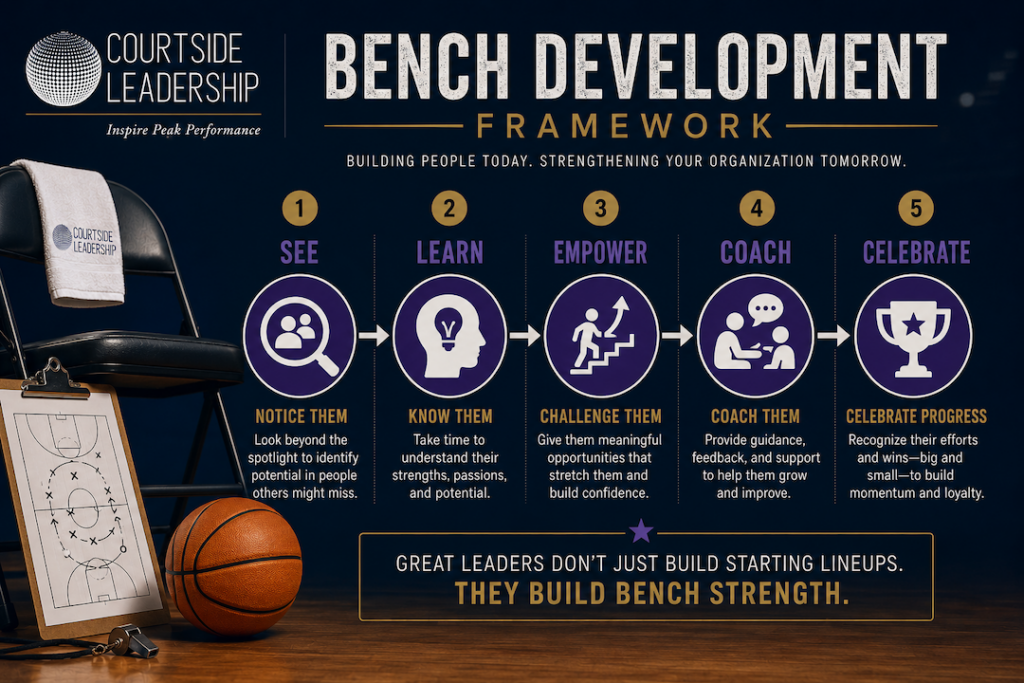
The Bench Development Framework
Over the years, I’ve become convinced that exceptional leaders intentionally coach the people who receive the least attention.
Here are five simple, practical commitments as a guide to develop your bench:
1. Notice Them
You cannot develop someone you rarely see. Leadership begins with awareness.
Who consistently sits quietly during meetings? Who rarely volunteers ideas anymore? Who always completes their work but seldom receives recognition? And who has potential that others haven’t noticed?
Sometimes the first step toward changing someone’s career is simply noticing they exist.
2. Know Them
Leadership isn’t about knowing job descriptions. It’s about knowing people.
Ask questions. What energizes them? Where do they want to grow? What strengths do they believe go unnoticed? What kind of work brings out their best?
People are far more than their current job title. Great leaders discover gifts before they’re fully visible.
3. Challenge Them
People don’t grow because leadership lowers expectations. People grow because leadership raises belief. Here are some ways:
- Give them meaningful work.
- Invite them into conversations.
- Assign ownership.
- Stretch their abilities.
Growth requires discomfort. But it also requires support. Challenge without coaching creates anxiety. Coaching without challenge creates complacency. The best leaders provide both.
4. Coach Them
Feedback should never be reserved for top performers. Every employee deserves meaningful coaching.
Specific. Frequent. Actionable. Not annual, but weekly. Maybe even daily for some.
The best coaches don’t simply correct mistakes. They develop confidence.
5. Celebrate Progress
Celebrate the small wins:
- Improvement.
- Courage.
- Initiative.
- Learning.
Every small success becomes proof that greater responsibility is possible. At the same time confidence grows. People who believe they are improving almost always continue improving.

Accountability Should Never Depend on Status
One leadership mistake I see often is inconsistent accountability. Stars receive grace. New employees receive criticism. Veterans receive flexibility. Others receive rigid expectations.
It begins to feel like favoritism.
Great cultures have a different approach. The best player on the team is held accountable. And so is the newest employee. The last person on the bench doesn’t need lower expectations. They need equally clear expectations.
Fair leadership isn’t treating everyone identically. It’s ensuring everyone has access to the same opportunity for growth. That distinction changes cultures.
Don’t Mistake Quiet for Complacency
One of the greatest mistakes leaders make is assuming silence equals disengagement. Sometimes it does, but often it doesn’t. Sometimes silence is just uncertainty, or fear. Sometimes it’s someone waiting for permission to contribute.
I’ve coached athletes who rarely spoke during practice. It drove me crazy. Then one conversation with one player changed everything. I asked for their opinion. Someone finally believed they had something to offer. Their leadership emerged because someone invited it. That set a new standard for the quiet players.
How many employees are waiting for that invitation today? How many future leaders are quietly sitting through meetings wondering whether anyone sees them? Leadership begins by asking.
One Conversation Can Change a Career
Think back through your own life. I’ll bet someone believed in you before you fully believed in yourself. Maybe it was a coach, teacher, supervisor, parent, grandparent, or a mentor. They saw something others overlooked. That belief changed your trajectory.
Leadership has always worked that way. Very few successful people arrive there alone.
Someone noticed them, challenged them, or opened a door for them. Someone refused to let them define themselves by their current circumstances. And that changed everything.

The Leadership Challenge
Here is a challenge for you.
Think about your team. Not your highest performer or the one tagged to be your future executive. Not the person who already gets the nods. Think about the last person on your bench.
The employee who isn’t on the high-profile project. The teammate who rarely speaks. The new hire still trying to find their footing. The person whose contributions often go unnoticed.
Schedule a conversation. Not a performance review, but a “development” conversation.
Ask four simple questions:
- What part of your job gives you the most energy?
- What strengths do you feel we aren’t using enough?
- What skill would you most like to develop this year?
- How can I help you get there?
Then do something many leaders never do. Build a visible, clear path together. A true plan with measurable successes and regular coaching. When people can see a future, they begin investing in it.
The Legacy of Great Leadership
Winning will always matter. So will performance and results. But great leadership is not solely measured by today’s scoreboard. It’s measured by tomorrow’s people. The greatest leaders don’t simply produce high-performing teams. They produce future leaders.
Take Mel for example. Here is the part of the story I haven’t told you:
“By her senior year, Mel had become our team captain.”
It wasn’t because she scored the most points, started every game, filled the stat sheet, or made the headlines. She became captain because every single player on that team trusted and respected her. When Mel spoke, people listened and this included teammates and coaches. She had earned something more valuable than playing time. She had earned influence.
Influence is leadership.
We went on to win the conference and went to the Big Dance (the NCAA Tournament) that year.
After graduation, Mel went on to medical school. Today she’s a physician. The player sitting at the end of our bench now makes life-and-death decisions every day. I’m grateful we never defined her by minutes played. Looking back, Mel didn’t need more minutes to prove her value. She needed leaders who saw beyond the box score.
Every organization has a Mel.
Maybe it’s someone who isn’t leading the meeting, or on the biggest project. Maybe it’s someone who hasn’t yet had the opportunity to show everything they’re capable of becoming. The responsibility of the leader isn’t simply to identify today’s stars. It’s to recognize tomorrow’s leaders before everyone else does.
If we build the bench, we build the future.
Because here’s the truth every leader needs to remember: The last person on the bench doesn’t want sympathy. They want significance. They want honest feedback and real opportunity. They want a visible path.
Being the last person on the bench should never feel like a ceiling. It should feel like the beginning of a journey.
Because one day, when they’re leading others, they will remember the leader who first believed they belonged. And that may become your greatest legacy.
Coach Barb’s Courtside Challenge
This week, walk through your office, your classroom, your department, or your facility with one question in mind:
“Who is sitting on my bench?”
Not literally. Leadership-wise. Then commit to one intentional conversation before the week is over.
You may discover that the person you’ve been overlooking isn’t your weakest employee. They’re simply your next success story waiting to be developed.
