Before I ever stepped into a boardroom, stepped on stage, coached a Division I basketball team, or founded a leadership company, I learned some of my most important leadership lessons in an unlikely place—an old hayloft above my grandparents’ barn.
If you’ll indulge me for a moment, I’d like to take you there.
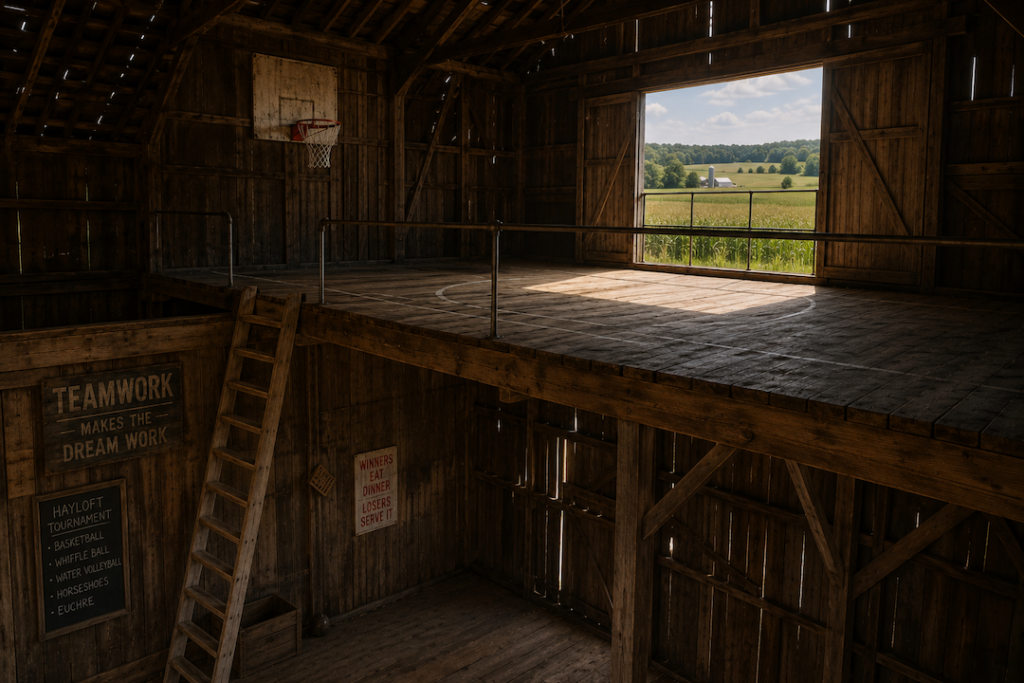
Picture an old Midwestern barn standing proudly among fields of corn, soybeans, and wheat. To reach the hayloft, you first had to climb a weathered wooden ladder fastened almost straight against the wall. It wasn’t an easy climb, but every trip up was filled with anticipation. Something special waited at the top.
As you stepped off the ladder, you entered a world unlike any gymnasium I’ve ever played in. The floor beneath your feet was made of wide white pine planks, worn smooth by decades of work and play. Time had left its mark. There were cracks, splinters, knots, and places where small pieces of wood had disappeared. The boards creaked and shifted beneath your feet. If you bounced the basketball in the wrong spot, you knew it immediately.
The hayloft had its own unmistakable scent—a mixture of aged wood, dry hay, summer heat, and hard work. Even today, decades later, I know I would recognize it instantly. Some places never leave you.
One side of the loft opened through a massive sliding wooden door. If you climbed onto the metal track beneath it, the view stretched for miles across fields that seemed endless. Brown horses grazed peacefully nearby. Below stood my grandparents’ farmhouse, once home to a family of ten and eventually the gathering place for countless birthdays, holidays, celebrations, and fiercely competitive family tournaments. Looking out over those fields, it felt as though the whole world was waiting.
Inside the hayloft stood one basketball hoop with a large white backboard.
Just one.

That single basket became the center of hundreds of games. Sometimes it was one-on-one. Sometimes three-on-three. Sometimes every cousin who happened to be around squeezed into a game. We invented the rules depending on who showed up. We kept our own score. Every change of possession meant taking the ball back before attacking again. Three barn walls formed the boundaries, while the wooden guardrail along the fourth side reminded you not to drift too far—or you might find yourself looking at a very long drop to the barn floor below.
Through the slats of that railing, you could see neatly stacked hay bales surrounding the upper level. Far below were rows of workbenches covered with tools, scraps of lumber, oil cans, ropes, tractor parts, and every piece of equipment needed to keep a family farm running. The barn was built for work. Somehow, we transformed it into a place for play.
Looking back now, I realize something remarkable.
At the time, I thought I was simply finding another place to practice basketball. Sometimes I went up there alone for hours, imagining game-winning shots and dreaming about playing at the next level. Eventually, those dreams carried me to a basketball scholarship at The Ohio State University and a career that would include more than three decades of Division I coaching.
But the hayloft gave me something even more valuable than a jump shot.
It quietly taught me how to lead. It taught me resiliency, leading through adversity, team development, decision-making, and mindset.
Long before I understood words like organizational culture, vision, adaptability, or resilient leadership, the old hayloft was teaching me those lessons one game, one summer afternoon, and one creaky floorboard at a time.
Years later, I can see that every imperfection in that old barn carried a leadership lesson. Those lessons have stayed with me far longer than any final score.
Here are six leadership lessons I learned from an old hayloft that continue to shape the way I lead today.
Lesson One
Great Leaders are Not Afraid of the Climb
Before there was basketball…
there was the climb.
The old wooden ladder wasn’t easy. It wasn’t comfortable. You had to decide the game was worth climbing for.
Leadership begins the same way.
Vision always requires a climb. Nobody accidentally reaches the place where they can see farther than everyone else.
The higher you climb, the farther you can see—and the more responsibility you have to bring others with you.
Lesson Two
Great Leaders Know Where Not to Step
The hayloft wasn’t perfect.
Old boards. Splintered wood. Knots. Cracks. Some places were solid. Others…not so much. Every kid knew where not to jump.
Leadership isn’t just about knowing what to do.
It’s knowing what can quietly bring the entire team crashing through the floor. Great leaders recognize weak spots before they become disasters. They don’t ignore them.
They protect the people around them, building a culture where those same people can thrive.

Lesson Three
Great Leaders Sometimes Run into a Wall
Three sides of the court ended with…
a wall.
More than once someone drove for what looked like an easy layup, only to discover they had run out of court.
We’ve all done it in leadership. We build momentum. We think we’re unstoppable.
Then reality reminds us there are boundaries.
The best leaders don’t resent the wall. They learn from it. In fact, they are continous learners, always open to self-improvement. Sometimes limitations don’t stop creativity…they create it.
Lesson Four
Great Leaders Prepare the Court Before They Play
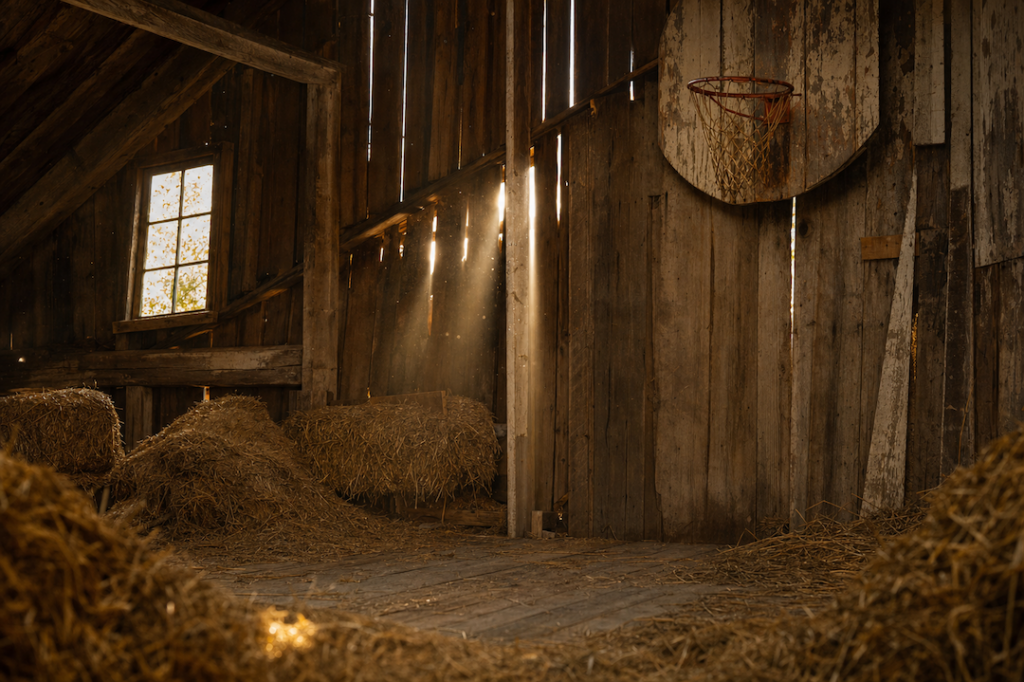
Sometimes there was still hay scattered everywhere.
Nobody complained. We grabbed a rake. Moved the bales. Swept the floor. Only then could the game begin.
Too many leaders want championship performance without preparing the environment. Using the famous words of the great Coach K (Mike Krzyzewski), “Everyone has the will to win. Champions have the will to prepare.”
Culture isn’t built during the game. It’s built before the game ever starts. Great teams perform well because someone prepared the floor.
Lesson Five
Great Leaders are Creative With the Constraints
There was only one basket.
Which meant…you had to invent the game. Half-court. One-on-one. King of the Court. Around the World. HORSE. Twenty-one. Three-on-three. Whatever worked for whoever showed up.
Nobody complained about what we didn’t have. We maximized what we did.
Great leaders don’t wait for perfect resources. They create possibilities from imperfect circumstances.
Lesson Six
Geat Leaders Shine When Things Get Hot
There wasn’t air conditioning.
Just heat. Dust. Humidity. Sweat. Sometimes you wondered how long you could stay.
Leadership isn’t difficult because of the easy days. Leadership matters because of the hard ones. Character is revealed when conditions become uncomfortable.
Anyone can lead when everything feels cool.
Real leaders rise up when things heat up.
Reflection
Years later, I’ve coached Division I athletes, built companies, spoken to executives, and studied leadership for more than four decades.
I’ve read the books, attended the conferences, and listened to world-class leaders.
But some of the greatest leadership lessons I’ve ever learned weren’t found in a boardroom, or a stage, or in a university, or a gymnasium, although all of those helped.
Some of the greatest leadership lessons were found in an old hayloft above my grandparents’ barn.
Looking back, I don’t remember whether I won every game or how many times my ball went over the guard rails or out the window of the hay loft.
But I do remember climbing the ladder, avoiding the weak boards, running into the walls, clearing away the hay, creating the games we played , and sweating profusely in the hot summer afternoons.
And I realize now that the hayloft wasn’t teaching me basketball. It was quietly teaching me about leadership.
Great Leaders, Leadership Lessons, Resiliency