
Great leaders don’t just communicate information. They share stories that inspire people to think differently, work together, and create meaningful change.
Imagine sitting in a meeting with a dozen colleagues. The discussion is moving quickly. Ideas are flying around the room. Decisions are being made.
And you have something important to contribute.
Maybe it’s a lesson from a previous experience. Maybe it’s a different perspective on a problem. Perhaps it’s a story about a customer, employee, or community member that could completely change the direction of the conversation.
But you hesitate. You wonder whether your perspective is valuable enough. You question whether it’s the right time to speak. You convince yourself that someone else probably has a better idea. So you remain silent.
The meeting ends. The opportunity passes. And the organization never benefits from the experience, insight, or wisdom you could have shared.
How often does this happen in organizations every day?
And what might change if leaders at every level recognized that their voices and stories could be among their greatest leadership assets?
The answer could transform the way we lead.
Storytelling Is Not Just Communication. It Is Leadership.
When we think about leadership, we often think about strategy, decision-making, performance, accountability, and most importantly, results.
All are important.
But there’s another leadership skill that deserves a place alongside them: storytelling.
Storytelling is one of the oldest ways humans have shared knowledge, established values, and created connections. Long before organizations had mission statements, strategic plans, or employee handbooks, people learned what mattered through stories.
They learned about courage by hearing about courageous people. They learned about perseverance through stories of overcoming adversity. And they learned about integrity by hearing what happened when someone chose to do the right thing, even when it wasn’t easy.
Today, those same principles apply in the workplace.
A leader can explain the importance of teamwork through a presentation filled with bullet points. Or that leader can share a story about employees from different departments coming together to solve a problem no single person could solve alone.
Both approaches communicate information.
But the story helps people see what teamwork looks like in action.
Information can explain what matters. Stories help people understand why it matters.
And when people understand the why, they are better equipped to connect their daily actions to a larger purpose.

1. Your Story Has Value Long Before You Feel Ready to Tell It
One of the biggest barriers to effective storytelling isn’t a lack of experience. It’s the belief that our experiences aren’t important enough to share. We often assume that influential stories must involve extraordinary achievements, dramatic failures, or life-changing moments.
But some of the most meaningful leadership lessons emerge from ordinary experiences.
Consider a manager who remembers the first time a supervisor genuinely listened to their concerns. Or an employee who recalls being given an opportunity when nobody else believed they were ready. Or a business owner who learned more from a failed project than from a successful one.
These stories may not make headlines. But they can change how someone leads.
The manager might become more intentional about listening. The employee might become the leader who recognizes overlooked talent. The business owner might create a culture where people feel safe discussing mistakes and learning from them.
Your story doesn’t have to be extraordinary to create extraordinary value.
It simply needs to offer something meaningful to someone else.
Leadership takeaway
Don’t dismiss an experience because it seems ordinary to you. Ask yourself:
- What did this experience teach me?
- How did it change the way I think or lead?
- Could someone else benefit from what I learned?
Sometimes the stories we underestimate are the very ones our teams need to hear.
2. Silence Can Cost Organizations More Than We Realize
Think about the knowledge that exists within your organization. There are employees with decades of experience. Others are new hires that bring fresh perspectives. There may be managers who have navigated difficult situations and team members who understand customers in ways senior leadership may not.
Every person carries experiences that could contribute to better decisions and stronger teams.
But those insights only create value when people feel comfortable sharing them. Silence in the workplace isn’t always a sign that people have nothing to say. Sometimes it’s a sign that they aren’t sure it’s safe to speak.
They may fear being judged, dismissed, embarrassed, or perceived as challenging authority. Other times, they simply haven’t been invited into the conversation.
For leaders, this presents an important responsibility.
Creating a culture where people have a voice is just as important as finding the confidence to use your own.
When leaders actively invite different perspectives, listen without immediately defending their positions, and recognize thoughtful contributions, they create conditions where people are more willing to share.
This is closely connected to psychological safety: the belief that people can raise questions, acknowledge mistakes, and offer ideas without fear of humiliation or punishment.
It doesn’t mean everyone must agree. It means disagreement can become productive rather than threatening.
Leadership takeaway
At your next team meeting, pay attention to who is speaking, and who isn’t.
Instead of simply asking, “Does anyone have questions?” try:
- “What perspective haven’t we considered?”
- “Who has experienced something that might help us approach this differently?”
- “What are we missing?”
Then give people time to respond.
Sometimes the most valuable insight in the room comes from someone who needed an invitation to share it.

3. Authentic Stories Build Trust Faster Than Perfect Speeches
Imagine two leaders addressing their teams after a difficult quarter.
The first leader delivers a polished presentation filled with performance metrics, corporate language, and carefully prepared statements.
The second leader acknowledges the challenges, explains what the organization has learned, shares an example of employees responding with resilience, and outlines a credible path forward.
Which leader is more likely to create a meaningful connection?
The answer isn’t necessarily the person with the best presentation. It’s often the person who communicates with honesty, clarity, and humanity. Employees don’t need leaders who pretend to have every answer. They need leaders they can trust.
And trust grows when a leader’s words consistently align with their actions. Authentic storytelling allows leaders to demonstrate their values rather than simply announce them.
For example, a CEO who says, “We value our employees,” makes a statement.
A CEO who shares how an employee’s idea led to a meaningful improvement—and explains how the organization acted on that idea—provides evidence of that value.
The distinction matters.
People are more likely to believe organizational values when they can see those values demonstrated through real experiences.
Of course, authenticity requires judgment. Not every personal experience belongs in a professional setting. Effective leaders share stories that serve the audience, respect confidentiality, and connect to a meaningful lesson.
The goal isn’t to reveal everything. The goal is to communicate something true and useful.
Leadership takeaway
Before sharing a story, ask:
“Am I telling this story to impress people, or to help them?”
The most effective leadership stories place the lesson—and the audience—ahead of the storyteller.
4. Stories Shape Organizational Culture
Every organization has a culture. And every culture has stories.
Some are told during onboarding. Others circulate in hallways, break rooms, team meetings, and conversations between coworkers. There are stories about how the organization handled a crisis. Stories about employees who went above and beyond. Stories about leaders who demonstrated courage. And sometimes, stories about decisions that contradicted the organization’s stated values.
These stories become part of the organization’s collective memory. And they help employees understand what is truly rewarded, tolerated, celebrated, and expected.
Consider a company that claims innovation is a core value.
If employees repeatedly hear stories about people being punished for unsuccessful experiments, the actual message becomes clear: taking risks is dangerous.
Now imagine a different organization where leaders share stories about thoughtful experimentation, lessons learned, and improvements that emerged from unsuccessful attempts.
That organization communicates a different message.
Learning matters. Initiative matters. Growth matters.
Culture isn’t built only through the values displayed on the wall. It’s built through the stories people tell about what happens inside those walls.
A Real-World Example: How Ritz-Carlton Uses Stories to Bring Its Culture to Life
What if one of the most powerful tools for strengthening organizational culture wasn’t another training program, strategic initiative, or leadership presentation? What if it was simply sharing a meaningful story?
For years, The Ritz-Carlton has demonstrated how employee storytelling can help reinforce organizational values.
Through its Daily Line-Up meetings, employees discuss service expectations, organizational priorities, and real experiences from colleagues. Its well-known “WOW Stories” highlight employees who have gone beyond expectations to create memorable guest experiences.
These stories do more than recognize excellent service. They provide concrete examples of what the organization’s values look like in practice. A story about an employee showing compassion becomes a lesson in customer care. A story about someone taking initiative becomes an example of personal accountability. And a story about colleagues working together becomes a reminder that outstanding service is rarely an individual accomplishment.
The significance of this practice has been documented by the National Institute of Standards and Technology and examined in business-school research. While storytelling alone cannot account for Ritz-Carlton’s business performance, its deliberate use of employee experiences offers an important lesson for leaders everywhere.
Culture becomes more meaningful when people can see themselves in the stories an organization celebrates.
Now imagine applying this concept to your own organization. What if every team meeting included one short story about someone demonstrating a company value? What if employees were encouraged to share moments when a colleague made a difference? What if leaders spent as much time recognizing examples of integrity, courage, and teamwork as they did reviewing performance metrics?
Over time, these conversations could help create something powerful: a shared understanding of what the organization stands for and how its people bring those values to life.
Because great organizational cultures aren’t built by repeating what matters. They’re strengthened by showing people what matters, recognizing those who demonstrate it, and inviting others to do the same.
Leadership takeaway
Identify three values that matter most to your organization. Then ask yourself whether you can tell a real story demonstrating each one.
If you can’t, that may be an opportunity to examine how those values are being practiced. If you can, share those stories. Recognize the people involved.
And consider this question:
If I asked five employees to tell me a story that demonstrates what our organization stands for, what would they say?
Their answers might reveal more about your culture than your mission statement ever could.

5. Great Storytelling Turns Individual Experiences Into Collective Learning
One of the most valuable outcomes of storytelling is its ability to transfer knowledge. Organizations spend significant resources developing talent, improving processes, and preparing future leaders. Yet valuable lessons often remain trapped within individual experiences.
A veteran employee retires, taking years of practical wisdom with them. A manager successfully navigates a challenging team situation, but the lessons never reach other departments. A frontline employee discovers a better way to serve customers, but the insight remains within one location.
These are missed opportunities. Storytelling can help turn individual knowledge into organizational learning.
When leaders encourage employees to share what happened, what they learned, and what they would do differently, experience becomes a resource others can use.
It also encourages reflection. Telling a meaningful story requires us to consider not just what happened, but why it mattered. That reflection can strengthen our own leadership development.
Leadership takeaway
Build storytelling into existing organizational routines.
During team meetings, invite employees to share a recent lesson. After completing a project, ask team members to describe a moment that changed their thinking. During onboarding, share stories that illustrate the organization’s values and expectations.
These don’t need to be elaborate presentations. A meaningful two-minute story can create a conversation that continues long after the meeting ends.
6. The Power of Storytelling Extends Beyond the Workplace
Leadership doesn’t stop when we leave the office. The stories we share can influence our families, neighborhoods, professional networks, and communities.
Consider a business leader who shares a story about overcoming an early career setback with a group of young professionals. That experience might help someone recognize that one failure doesn’t define their future.
A community leader who shares a personal experience of receiving support during a difficult time might inspire others to volunteer or contribute. An entrepreneur who explains how mentorship changed their career might encourage other business owners to invest in developing emerging talent.
One story can create a connection. That connection can inspire an action. And that action can create an impact that extends far beyond the original conversation.
Two More Organizations Using Stories for Connection and Purpose
Ritz-Carlton isn’t the only organization recognizing the value of storytelling.
Microsoft: Helping Employees Share Their Experiences
Microsoft has published employee stories highlighting experiences involving leadership, inclusion, innovation, and career development. These stories provide a platform for employees to share perspectives that might otherwise remain within their individual teams.
For leaders, the lesson is important: organizations become stronger when they create opportunities for people with different experiences to contribute their voices.
Patagonia: Connecting Personal Stories to a Larger Purpose
Through its Worn Wear initiative, Patagonia has shared stories about repairing clothing, extending the life of products, and the personal experiences people associate with their gear. These stories connect individual experiences with broader environmental values and encourage people to think differently about consumption.
For leaders, Patagonia demonstrates how storytelling can connect organizational purpose to everyday choices and community action.
Neither example proves that storytelling alone produces measurable business outcomes. Both, however, illustrate how organizations can deliberately use personal experiences to communicate values and encourage connection. And that’s an important distinction.
Leadership becomes more powerful when influence is used not simply for personal success, but for the benefit of others.
7. How to Become a More Confident Leadership Storyteller
The good news? You don’t need to be a professional speaker to become an effective storyteller. You don’t need a dramatic life story. And you certainly don’t need to be the loudest person in the room.
You need to become intentional about recognizing meaningful experiences and sharing them in ways that serve others.
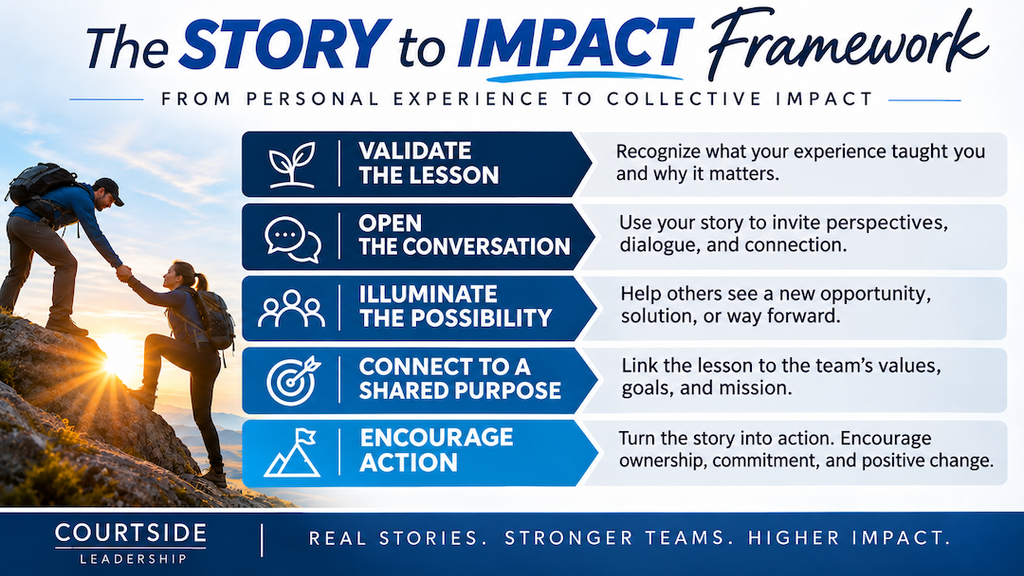
The STORY to IMPACT Framework: Five Steps to Leadership Storytelling
VALIDATE THE LESSON
Recognize that your experiences contain lessons worth examining. Don’t automatically dismiss your perspective because someone else has more experience or a bigger title.
OPEN THE CONVERSATION
Identify the lesson you want your audience to remember. A strong leadership story has a purpose beyond entertaining the listener.
ILLUMINATE THE POSSIBILITY
Help people see themselves in the experience. Describe the challenge, decision, or turning point in a way that makes the lesson relatable.
CONNECT TO A SHARED PURPOSE
Share your message with honesty and confidence. You don’t have to eliminate every nervous feeling before speaking. Often, confidence grows because you choose to speak.
ENCOURAGE ACTION
End with a meaningful takeaway. What should your audience think about, do differently, or carry forward?
The goal isn’t simply to tell a memorable story. It’s to help someone make meaningful use of it.
Can You Measure the Impact of Storytelling?
While it is difficult to isolate storytelling as the cause of organizational improvement, leaders can look for meaningful indicators.
- Are more employees contributing ideas during meetings?
- Do employees feel comfortable speaking openly?
- Can team members describe examples of the organization’s values in action?
- Are lessons from one department being shared with others?
- Are employees recognizing colleagues for demonstrating important organizational behaviors?
These questions can help leaders evaluate whether their communication practices are contributing to a stronger culture.
The goal is to create an organization where people learn from stories shared and put the lessons into action.
From Silence to Influence: The Leadership Challenge
Let’s return to that meeting room. The one where someone had something valuable to contribute but remained silent.
Now imagine a different outcome. Imagine that person chooses to speak. They share an experience that reveals a potential problem nobody else recognized. A colleague builds on the idea. The team considers a new approach. And the organization makes a better decision.
Perhaps that decision improves a process, strengthens a relationship, helps a customer, or creates an opportunity for someone else. It all began with one person deciding their voice was worth using.
Now imagine a workplace filled with people who feel empowered to do the same. Not people competing to be heard. People contributing to something greater than themselves.
That’s the kind of environment where storytelling becomes more than a communication skill. It becomes a leadership advantage. And it reminds us that influence isn’t measured only by job titles, organizational charts, or the number of people who report to us.
Influence can begin with a single conversation. A moment of honesty. Or a lesson shared. Or a voice that chooses to speak.

Final Thoughts: Someone May Need the Story You Haven’t Told Yet
Every leader has a collection of stories. Some are stories of success. Others involve mistakes, uncertainty, unexpected challenges, or difficult decisions. Some make us laugh. Others remind us of what matters most. Together, they represent the experiences that shape how we think, how we treat others, and how we lead.
The question isn’t whether we have stories worth sharing. The question is whether we’re willing to recognize their value and use them with intention.
Because somewhere in your organization, someone may need the encouragement that comes from hearing how you overcame a challenge. Someone may need to know that a mistake doesn’t have to end their career. Someone may need to see what courage, compassion, or integrity looks like in practice. And someone may be waiting for the confidence to share their own story.
You don’t have to have the perfect story to become an influential leader. You simply have to recognize the power of your experiences, find the courage to share them, and use the lessons to lift others.
When leaders find their voices, teams gain perspective. When teams share their stories, organizations build connections. And when organizations use their influence for good, entire communities can benefit.
That’s how we move from silence to influence. And that’s how stories help build something greater than ourselves.
_________________________________________________________________________________________________
Bring the Power of Storytelling to Your Organization
At Courtside Leadership, we believe great teams are built through trust, meaningful communication, shared purpose, and intentional leadership.
Through engaging keynotes, interactive leadership workshops, and team development experiences, Courtside Leadership helps organizations strengthen relationships, develop confident leaders, and create cultures where people feel valued and empowered to contribute.
Your organization has stories worth telling. Let’s make sure those stories are helping build the team and culture you want to create.
Connect with Courtside Leadership to explore a keynote or team-building workshop for your organization.
